In modern marketing, the problem is no longer access to data. It is knowing what to do with it.
Teams today are surrounded by dashboards, reports, and metrics. Yet many still struggle to turn that information into clear, confident decisions. Data lives in too many places, definitions do not always match, and by the time reports are ready, the moment to act has often passed.
For the team at Coupler.io, solving this challenge starts with a different mindset. Instead of building more reports, the company is focused on helping every marketer work as if they have a data analyst alongside them.
At the center of this approach is a simple idea. When data is clean, structured, and accessible, it becomes far easier to use.
“Most marketers don’t actually have a software problem. They have a data readiness problem,” says Ivan Burban, Head of Marketing at Coupler.io. “Marketing teams are surrounded by tools, but the data inside them is fragmented, inconsistent, and often unreliable. That creates a dependency on analysts to clean and validate everything before it can be used.”
Closing the Data Readiness Gap
That dependency has shaped how marketing teams operate for years. Data flows in from websites, ad platforms, CRM systems, and social media, but rarely connects in a meaningful way. Instead, teams wait for someone (like an experienced analyst or data engineer) to pull everything together, reconcile differences, and confirm accuracy. What to do if teams don't have ‘someone,’ but analytics is needed now?
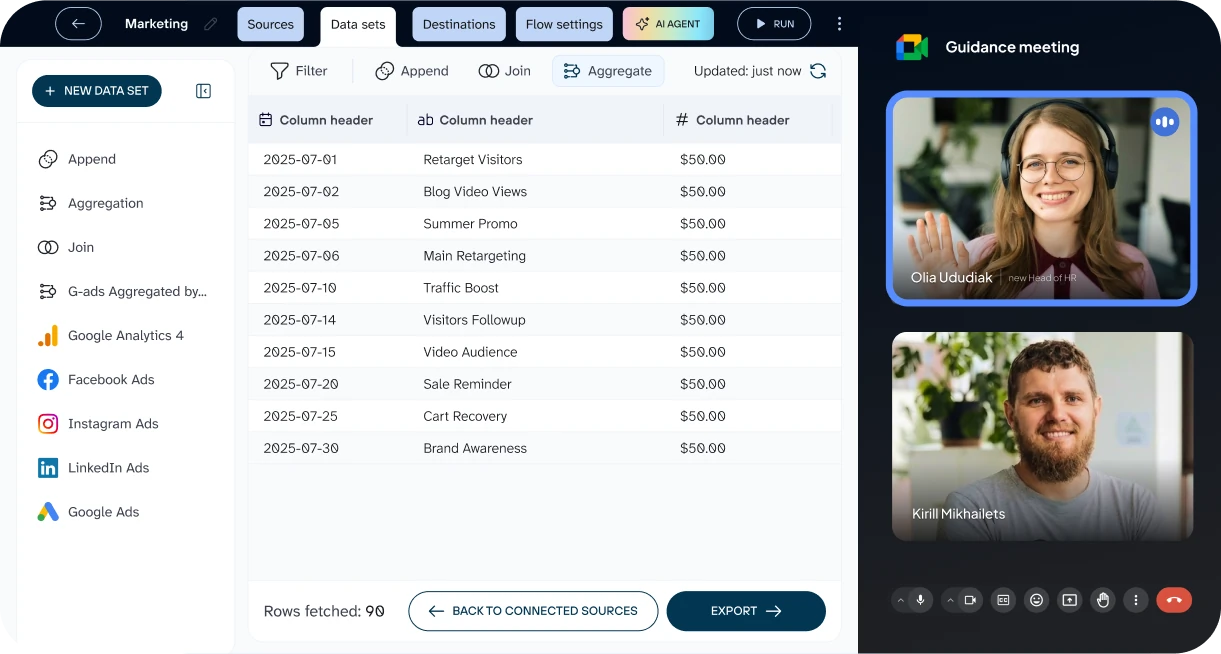
Coupler.io is designed to remove that friction. By transforming raw data into structured datasets ready for use, the no-code platform brings analysis closer to the people who need it most.
“We’re enabling every marketer to work with structured, reliable datasets that are already prepared for analysis, without pricy setup,” Burban explains. “So instead of asking someone else for insights, they can explore the data themselves and make decisions with confidence.”
The difference shows up in how teams move. When data is immediately usable, decisions happen faster. Campaign managers can adjust performance while campaigns are still live. Growth teams can spot patterns as they begin to form. Leadership can see what is happening now, not what happened last week.
It is a shift from reacting to results to shaping them in real time.
From Data Movement to Data Preparation
Much of this is powered by Coupler.io’s Analytical Engine. Its role is not simply to move data from one place to another, but to prepare it. Data from multiple sources is brought together and refined so that marketing teams can work from a consistent, reliable foundation.
“The key is data preparation,” says Burban. “Our product offers a solution to align metrics, resolve inconsistencies, and confirm reliability before reporting or analysis.”
This focus on preparation becomes even more important as the idea of data-driven marketing continues to evolve. For a long time, being data-driven meant having dashboards. But dashboards alone do not create clarity; they simply present information. Today, the expectation is different.
Bringing multi-channel data together creates the context needed to understand performance in a meaningful way. There is also a growing shift toward real-time insight. Updating reports on a schedule is no longer enough. Teams need to see what is happening as it happens and understand the reasons behind it.
AI can meet those expectations, as we move from classic data-driven marketing to AI-driven marketing.
AI Raises the Stakes for Data Quality
Claude and other AI tools are changing how people interact with data. Marketers can now ask questions in plain language and get answers instantly. But that convenience comes with a tradeoff. The quality of the answer depends entirely on the quality of the data behind it.
“AI is powerful, but it’s also misunderstood,” Burban says. “A lot of companies are rushing to adopt AI for marketing analytics without addressing the quality of their data. That leads to outputs that can be inconsistent or misleading.”
Coupler.io takes a more deliberate approach. Instead of just pushing raw data into AI systems (like Claude or ChatGPT), it focuses on preparing that data first. The goal is to ensure that anything built on top of it has a reliable foundation.
“Coupler.io's Analytical Engine structures the data first, so AI operates on prepared, reliable information,” Burban explains. “That reduces risks of AI's hallucinating, delivers higher-quality, contextual insights.”
In this model, AI becomes a layer that enhances access to insight, not a shortcut around the work required to produce it.
Building Toward a More Agile, Aligned Future
Another factor shaping modern marketing is the increasing importance of first-party data. As privacy standards evolve and third-party signals become less dependable, companies need to rely more on their own data. That makes it even more important to connect and activate that data across systems.
For marketing teams, the benefits extend beyond performance. When everyone works from the same structured dataset, alignment improves across the organization.
“It removes a lot of clarifications,” Burban says. “There’s no debate about whose numbers are correct. Everyone is working from the same source.”
It also opens the door for more people to engage with data directly. Marketers no longer need deep technical skills to get answers. They can explore the data, test ideas, and act on insights without waiting for analysts’support.
The result is a more agile way of working, where insight is shared rather than centralized.
From Insight to Interaction
Looking ahead, this shift will only accelerate. Interacting with data is becoming more natural, especially as conversational interfaces improve. But that future depends on getting the basics right.
“We’re moving toward a world where interacting with data through AI feels more like a natural conversation,” Burban says. “But that only works if the fundamental principles are fulfilled, meaning data flows are running smoothly, enriched with business context.”
For marketers investing in this foundation, the benefits include faster decisions, better alignment, and stronger adaptability. Ultimately, the goal is not more data flows, but proactively acting on existing data at scale.
That shift is what turns data from a challenge into an advantage, and what allows every marketer to think and operate like a data analyst.