The contact center has become a technology battleground over the past several years. Much of it is centered on what happens when a customer or prospect contact the company. But, there’s a whole different piece of the contact center that is often forgotten because it happens before the interaction actually starts. It’s the outbound call, which has been integral to the success of the contact center space from the beginning.
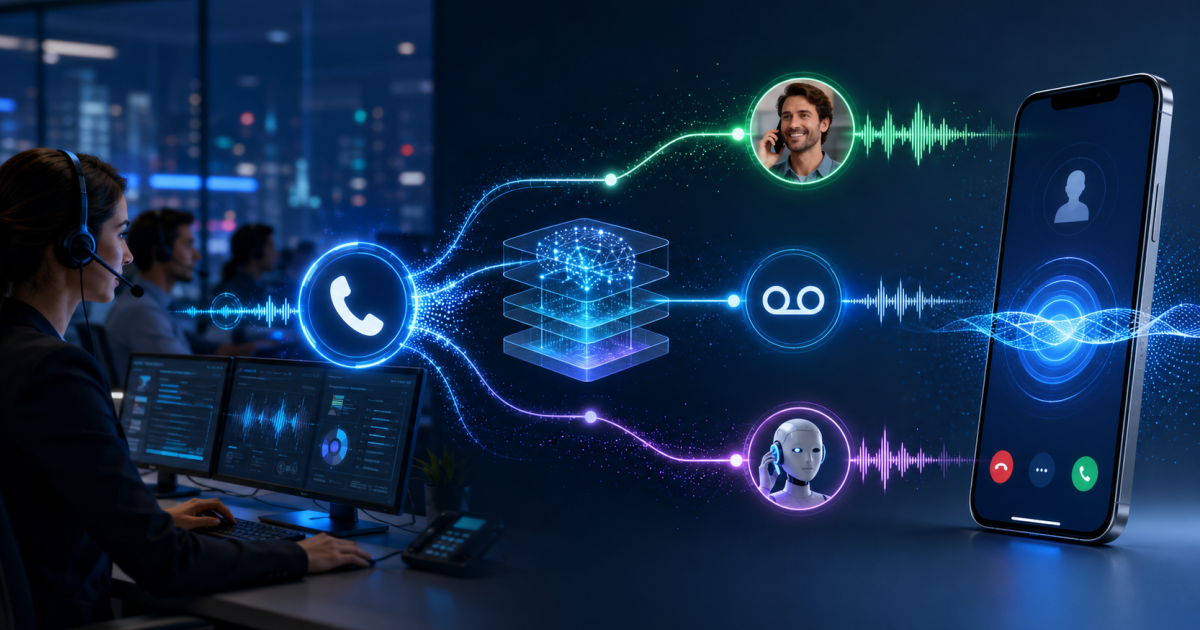
A dialer fires, a connection is made and, in a fraction of a second, the system has to determine what is actually on the other end of the line. Is it a person? A voicemail system? A screening prompt? Or an AI intermediary?
When the main issue was distinguishing between live voice and a recorded greeting, the solution was simpler. Legacy answering machine detection (AMD) systems were trained to distinguish between the two and route calls accordingly. The problem is, technology has evolved and outbound platforms operate in very different environments today.
Smartphones have added a new screening layer, for instance. Apple’s iOS Live Voicemail transcribes calls in real time, so users can decide whether to answer. Google Pixel’s Call Screen can intercept the call, ask the caller to state their purpose, and relay the response to the user. Carrier-native filtering and third-party apps add even more variations. In other words, the old acoustic assumptions behind answering machine detection don’t map cleanly anymore.
The challenge is that, when a system misreads a screening prompt as a live human, agents end up wasting time waiting through automated flows. When it misclassifies a real person as a machine, the opportunity to connect disappears instantly, before the conversation starts, resulting in a missed opportunity. In high-volume outbound environments, these kinds of seemingly small errors add up and reduce agent efficiency, lower contact rates, and generally weaken campaign economics.
TCN thinks it can help. The company launched SmartAMD, its AI-powered answering machine detection and call-sorting system, which is built into its Operator platform. The idea is pretty straightforward. Instead of relying on a single classifier to make every decision, SmartAMD uses specialized machine learning models in parallel. A foundational model makes the primary human v. machine decision almost instantly. Simultaneously, secondary models identify the specific type of screening system or voicemail greeting that’s being used.
Those secondary models matter because different screening layers need to be handled differently. An iOS Live Voicemail experience is different from a Google Call Screen prompt — and both are different than a standard voicemail greeting. With a system that only labels these intermediaries as non-human is limited to disengaging or generic re-routing. On the other hand, by identifying the specific machine, a contact center has a range of options. It can disconnect cleanly, route to an agent, or deliver a targeted, brand-consistent message into the screening layer.
Dave Bethers, Senior VP of Client Success and Product at TCN, put the idea into an economic context.
n in , framed the logic in economic terms: agent time is the most expensive resource in the contact center, and protecting that time has become harder as handset-based AI screening has grown more common. That is what the dual-engine design is intended to address: cheap filtering where standard AMD still works, and higher-precision detection where the environment has become more complex.
“Agent time is our most expensive resource and our greatest opportunity cost, and protecting agent time is harder than ever,” he said. “That is why we developed a dual-engine approach. We stop wasting money where cheap tech works, and we stop wasting agent time where precision is required."
Early performance reports are positive. In a deployment spanning more than 1.6 million calls for a large enterprise client, TCN says:
- SmartAMD increased agent utilization by 13%,
- The right-party contact rate for agent-connected calls lasting more than 40 seconds improved from 7.6% to 8.7%, and
- The reported ROI reached 8.8x, or $8.80 for every $1.00 invested.
The RPC improvement is important. A one-point increase may not seem significant, but on paper, a one-point increase may not sound significant but, in reality, it represents 14% growth. At the scale of millions of dials, that’s a meaningful number of conversations that legacy detection systems likely would have missed, abandoned, or mishandled.
There is also a longer-term data advantage. Because SmartAMD classifies each connected call by precise outcome type, contact centers have more granular disposition data for campaign managers. Over time, that can help drive an understanding of which customer segments are more likely to use screening tools, how carrier behavior is changing, and where call timing or campaign logic should be adjusted.
Modern outbound calling is not simply about detection; it’s about adapting to new technologies in the response environment, which has become layered, dynamic, and increasingly AI-mediated. Outbound systems that can classify precisely, learn continuously, and route more intelligently will help increase instances of the outcome that matters most: A live human conversation.
Edited by
Erik Linask