Early enterprise AI generally worked behind the scenes. It scored leads, summarized calls, flagged fraud, and analyzed customer behavior after the fact. It was abundantly useful, for sure, but it needed more because it was doing work that happened once the moment of customer intent had already passed and, with it, a moment of opportunity.
The live conversation was a weak point. A prospect filled out a form and waited. A customer called after hours and got voicemail. A text inquiry landed in a queue that wasn’t monitored frequently enough. This is not new; the gap between interest and response has historically been one of the most expensive leaks in the revenue funnel.
The latest wave of conversational AI is making a difference, though, and is working to close that gap. The opportunity is not just to automate customer interactions, but to respond in a more timely manner before intent fades — at the moment a lead becomes a conversation.
According to Invoca, 56% of consumers expect a response within one hour of submitting a form, yet only 36% actually receive one. That may seem like a CX problem — and it is — but it’s also a revenue problem. Every delayed follow-up represents a lead that may cool off, choose a competitor, or disappear entirely before engagement happens. In fact, 79% are prepared to switch to a faster competitor if they don’t get a response when they expect it. In industries that are prone to high-intent interactions, like healthcare, home services, insurance, financial services, automotive, and telecom, customers generally want a real conversation before they commit, so that lag can be costly.
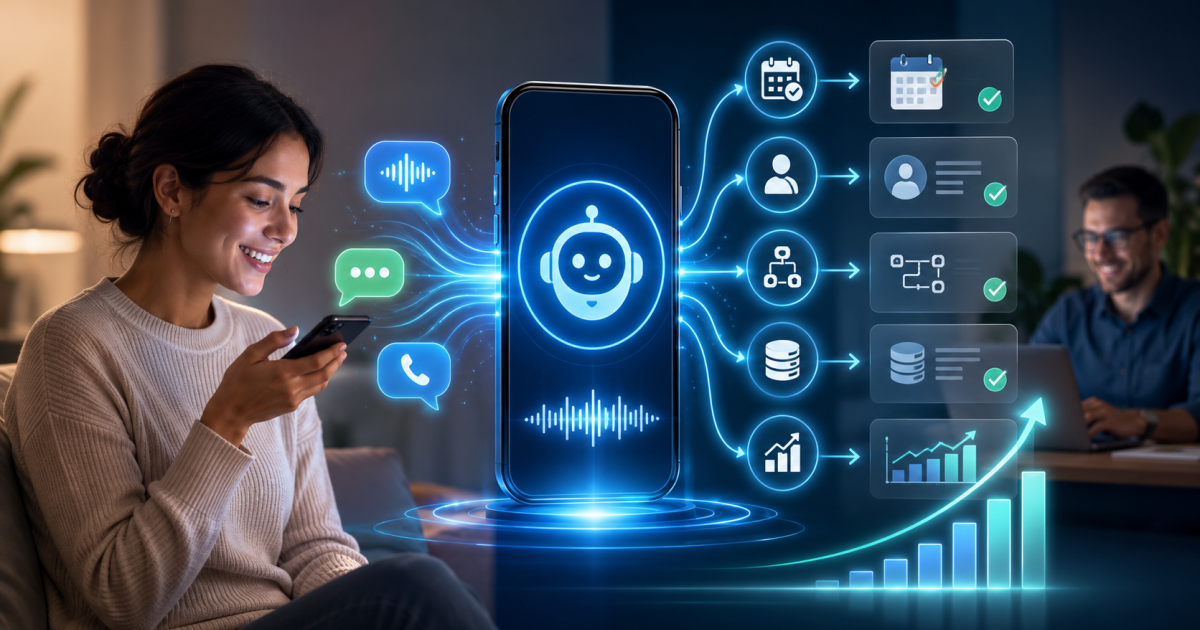
Invoca is trying to solve the problem with Nico, its new AI agent, specifically designed as a revenue conversion agent that engages, qualifies, and converts leads across voice and SMS, responding the moment a consumer calls, texts, or submits a form. The company says Nico can qualify intent, book or reschedule appointments, route high-intent calls to a live agent, answer questions that move a buyer closer to purchase, re-engage people who abandon online scheduling, and escalate support requests to the appropriate resource. Basically, it is built to keep high-intent conversations moving instead of letting them stall out.
Speed is one part of the equation, but Invoca is positioning the agent in a high-performance context. Rather than relying on generic training data, Nico is trained on each brand’s own first-party data and its best-performing conversations. AI is only as good as the data on which it’s trained and, in Nico’s case, the exchanges where top reps actually convert interest into revenue become the training data.
Invoca is also putting a lot of emphasis on attribution. One of the persistent blind spots in phone and text-based marketing has been the difficulty of connecting those conversations back to the campaign that drove them. Nico is designed to tie outcomes back to the original marketing source, whether that was a website form, inbound phone call, Google Local Services Ad, Google Ads lead form, Meta lead ad, Yelp, or other campaign. That’s a key feature for marketing teams, who gain better visibility into which campaigns perform best.
This visibility isn’t an accident. Invoca has already been focused on connecting marketing spend to the outcomes that happen in conversations, especially those that occur over phone and messaging and is now extending that logic to Nico.
Nico integrates with systems like Salesforce, HubSpot, and NexHealth, allowing businesses to automate lead capture and scheduling inside the tools they already use. That’s an important feature because AI agents create real business value when they are connected to the workflow systems where follow-up and revenue execution actually happen. An agent that can talk is useful, but an agent that can talk, qualify, schedule, and document the outcome in the right system is exponentially more valuable.
An early University Hospitals example gives a practical sense of how Nico might play our in a healthcare setting. According to Invoca, Nico recovered 25 appointments on its first night live by engaging patients after hours. On a separate occasion, the AI recognized that a patient inside the hospital needed on-site assistance and directed him to find a staff member, rather than continuing the AI-human interaction. That’s an important part of the AI puzzle — and one that presents a design challenge in many cases — building agents that can move conversations forward effectively while recognizing when human help is needed.
There’s an interesting point in Invoca’s data that isn’t talked about much, but clearly holds value: 83% of consumers want AI to identify itself. In other words, people want to know that they are interacting with an AI agent. It makes sense. We are used to a human agent answering the phone and introducing themselves. Why shouldn’t an AI agent do the same? If nothing else, it provides transparency, builds trust, and responds directly to a customer request.
That said, this isn’t really a story about AI replacing human agents. While there’s been a lot of talk about that., arguably, the strongest use case is not fully autonomous handling of every conversation, but automation for high-volume, repeatable, high-intent interactions that often go unanswered or under-served, paired with appropriate and clean escalation when the situation calls for it. From the perspective, AI is not replacing human reps, but making sure those reps spend more time on the conversations that actually require their judgment.
Edited by
Erik Linask