For decades, contact center technology has been designed to keep human agents talking. Agentic Voice changes the question from how to keep agents busy to how to get the work done.
The contact center has spent decades trying to solve a particular economic problem: human agents are expensive, their time is limited, and every minute they spend waiting for the next conversation is a minute they are being paid without producing much value.
That problem shaped the technology, the operating model, and even the way contact centers measure success.
Dialers were built to address it. Predictive dialing, call pacing, answer detection, and queue management all help ensure that human agents spend as much time as possible doing what they were hired to do: talking to customers and prospects.
Now, Agentic Voice is changing the economics.
An AI voice agent can conduct a conversation, gather information, make decisions within defined boundaries, interact with business systems, and take authorized actions. Multiple agents can operate concurrently, potentially at a scale that would be impractical with a human workforce.
This is not simply another way to automate a phone call. It challenges assumptions that have shaped the contact center for generations.
The Dialer Defined the Contact Center
Consider the traditional outbound contact center.
An organization hires agents, provides them with training and systems, and pays for their time. But, an agent cannot spend every minute talking to a customer. Calls go unanswered. People hang up. Voicemail systems intervene. Agents wait for the next call to arrive.
The dialer exists, in part, to reduce that waste.
Predictive dialers estimate when agents will become available and initiate calls accordingly. Answer detection helps distinguish live answers from other outcomes. Campaign pacing attempts to balance the risk of having agents idle against the risk of customers answering when no agent is available.
The entire arrangement reflects the economics of human attention.
It also explains why contact centers pay so much attention to occupancy, utilization, talk time, idle time, and average handle time. These metrics are not arbitrary. They help managers understand how effectively a costly, limited resource is being used.
The same logic influences staffing, scheduling, campaign design, and performance incentives.
For decades, the central operational question has been some variation of, “How do we get more productive work out of the human capacity we are paying for?”
Agentic Voice Changes the Economics
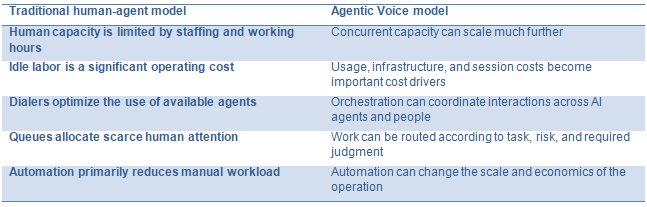
AI voice agents change the cost equation, although not quite as simply as saying that AI costs nothing when it is idle.
Human agents incur labor costs throughout their shifts, whether they are speaking, waiting, or handling other parts of their work. AI voice agents generally incur usage-related costs as they process and conduct interactions. Those costs can include model processing, orchestration, telephony, infrastructure, and session management, depending on how the system is designed.
The distinction matters because AI capacity can often be provisioned and scaled differently from human capacity. Organizations can potentially handle many more simultaneous interactions without hiring and scheduling a corresponding number of people.
The economic constraint shifts from the availability of human attention toward the cost, value, and successful execution of each interaction.
This does not mean every AI interaction will be cheaper, or that every task should be handed to an AI agent. Poorly designed interactions, unnecessary calls, failed integrations, and ineffective campaigns can still destroy value.
It means the assumptions used to design and manage the operation need to be reconsidered.
The Old Operating Model Does Not Automatically Fit
Imagine a company running an outbound sales campaign. In a traditional model, the dialer connects a prospect to an available representative. The representative conducts the conversation, qualifies the prospect, records the result, and arranges the next step.
Now, imagine an Agentic Voice system that can contact prospects, qualify interest against defined criteria, update the CRM, schedule appointments, and escalate promising or unusual cases to a human salesperson. The human salesperson is no longer necessarily the starting point for every interaction. Instead, the human becomes one participant in a broader process.
The objective is no longer simply to maximize the number of minutes people spend talking. It is to identify which interactions should happen, execute them effectively, capture the results, and move qualified opportunities forward.
That distinction changes how a campaign should be designed. A company might decide to contact more prospects because additional capacity is available. It might instead use the same volume to improve qualification, follow up more quickly, or respond to opportunities that previously went untouched. It could reserve human involvement for conversations where judgment, negotiation, or relationship-building is most valuable.
The right choice depends on the business objective, not on a blanket assumption that more automation is always better.
The New Division of Labor
The future contact center is unlikely to be a simple choice between humans and AI.
AI agents may be well suited to high-volume, structured interactions: confirming appointments, collecting information, qualifying leads against established criteria, and completing routine transactions. Human agents remain essential when situations require nuanced judgment, complex problem-solving, empathy, negotiation, or accountability that cannot be delegated.
The difficult part is deciding how the work should be divided.
- Which interactions can an AI agent complete independently?
- Which require human approval? What happens when a customer asks for a person?
- How much context should accompany a handoff?
- Who is responsible when an agent completes an action that technically follows its instructions but produces a poor business result?
These are operating-model questions, not merely model-selection questions.
The answers also need to account for risk. A routine appointment reminder and a conversation involving a disputed payment should not necessarily have the same permissions, escalation rules, or tolerance for error.
A well-designed operation allocates work according to its value, complexity, risk, and need for human judgment. It does not simply automate everything that can be automated.
The Metrics Will Have to Change
If an organization continues to judge an Agentic Voice operation primarily by the metrics developed for human agents, it risks optimizing the wrong thing.
Occupancy and talk time still matter when managing a human workforce. Cost per interaction can still be useful when comparing alternatives. But, none of these measures, on their own, tell us whether the business accomplished what it intended.
A sales campaign should be evaluated by qualified opportunities, appointments kept, conversion rates, and, ultimately, revenue. A service operation should consider resolution quality, customer effort, repeat contacts, and the successful completion of requested actions.
Operational measures remain important, including completion rates, failed interactions, escalation rates, and cost per successful outcome. They help explain why results are good or bad.
The distinction is between measuring activity and measuring value.
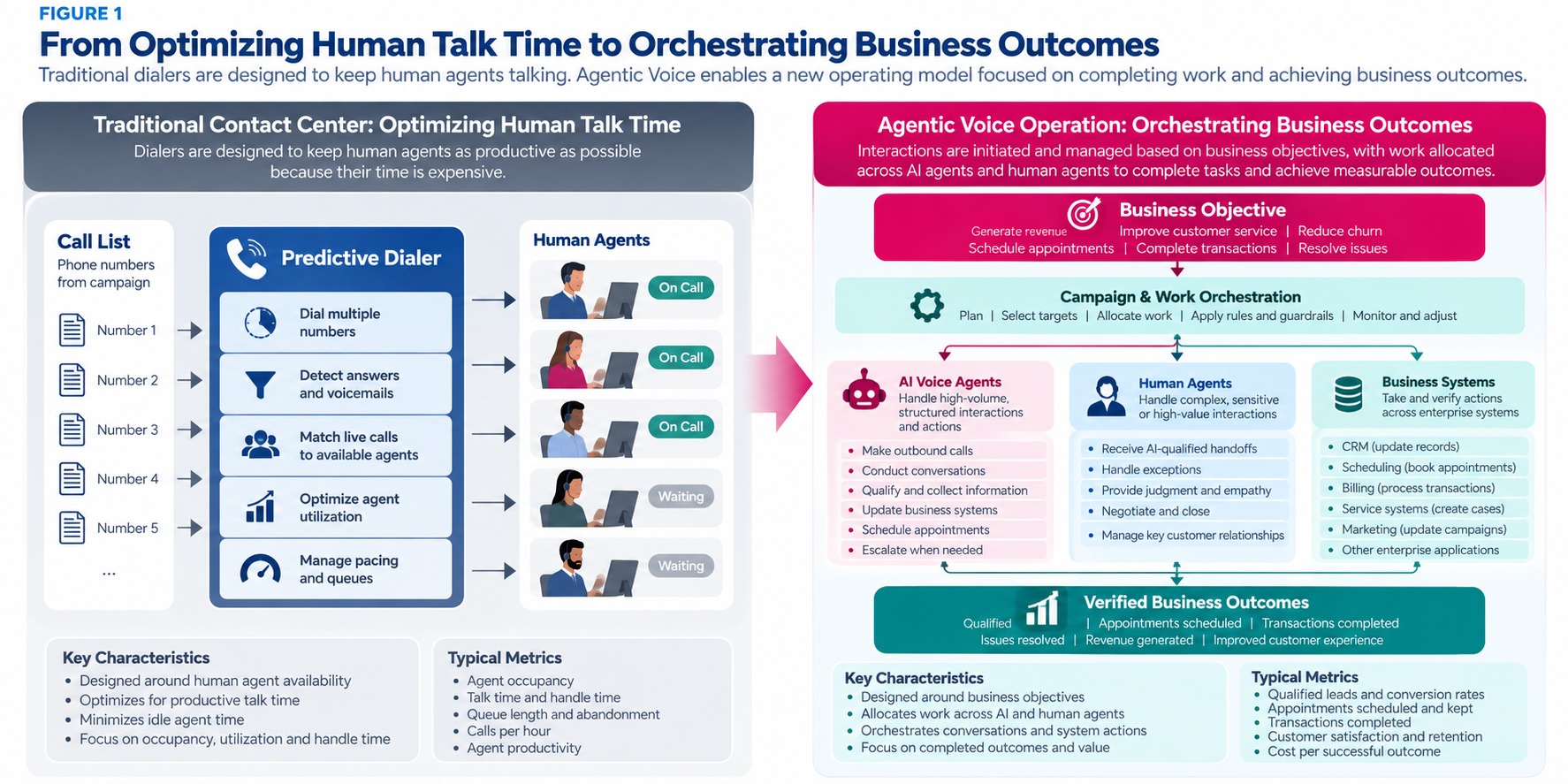
A system that conducts thousands of conversations but generates few useful outcomes may be operating efficiently in a narrow technical sense while failing commercially. A smaller number of well-targeted interactions that produce verified business results may be far more valuable.
The objective is not to maximize conversations. It is to maximize the value of the work those conversations accomplish.
The Dialer Needs to Evolve Too
This shift has implications for the infrastructure that initiates and manages outbound interactions.
A dialer designed around human availability must consider agent capacity, pacing, and the timing of connections to available representatives. An environment built around Agentic Voice has different requirements. It needs to coordinate interactions with AI agents, manage concurrency, connect conversations to the appropriate systems, and account for the outcomes of the work being performed.
That does not make traditional dialer capabilities obsolete. Campaign management, pacing, call handling, and operational control remain relevant. What changes is the resource being coordinated and the objective being optimized.
This is the problem a new generation of dialer infrastructure is beginning to address. Cloudonix's PipeX, being developed as a dialer for Agentic Voice, is one example of this emerging direction.
The larger point is not the arrival of any one product. It is that outbound infrastructure needs to evolve alongside the systems it serves. Treating AI agents as if they were simply human agents with a different voice misses the opportunity to rethink how campaigns, capacity, and business processes work together.
The Contact Center May Become Something Different
The collision between contact centers and Agentic Voice is not fundamentally about whether AI will replace human agents. That question is too narrow.
It is about what happens when the economics of conducting conversations change, when more interactions can happen concurrently, and when a conversation can trigger actions across business systems without requiring a human to perform every step.
The result may look less like a traditional call center with AI added to it and more like an operation that coordinates people, AI agents, communications infrastructure, and business applications around defined outcomes.
That transformation will require new management practices, different metrics, clear accountability, and infrastructure designed for the new operating model. It will also require organizations to decide which activities should be automated and which are valuable precisely because a human is involved.
For decades, contact center technology has been designed to keep human agents talking. Agentic Voice changes the question from how to keep agents busy to how to get the work done.
Eric Klein is the Founder and COO of Cloudonix, a leading provider of AI-powered communications infrastructure and the creator of the AI-first Business Phone System. With more than two decades of experience in telecommunications, cloud communications, and emerging technologies, he has helped organizations navigate the intersection of innovation, operations, and regulatory compliance. Klein is a recognized industry thought leader who regularly writes and speaks on topics including AI communications, telecom regulation, fraud prevention, and the evolving role of intelligent voice technologies in modern business.Edited by
Erik Linask