The customer experience (CX) is something many of us take part in every day; usually, as the customer. As customers, it directly impacts our satisfaction and loyalty. From a company's perspective, it impacts their success.
Satisfied customers are more likely to repeat purchases, recommend a brand to others, and remain loyal to a company over time. Positive CX builds a strong emotional connection between a brand and its customers. This leads to increased brand advocacy and trust. Conversely, negative CX damages a brand's reputation, deters potential customers and erodes existing customer relationships.
To keep customers happy, businesses need to adapt to their needs. Today’s tech-savvy customers prefer to go the self-service route.
But companies, in general, may not be meeting that need.
A Cisco survey shows that customers are frustrated with the current state of self-service tools. Many essential tasks, like rescheduling flights or reporting lost cards, still require live agents. This often results in lengthy wait times, multiple transfers and overall dissatisfaction for customers and agents.
This then leads to another issue: Customer service reps are often overwhelmed with information and tasks, which slows down problem-solving and hurts customer satisfaction. According to Webex by Cisco, one in three agents doesn't have enough information to provide top-notch customer service.
To overcome these hurdles, Cisco recently introduced new AI tools (including Webex AI Agent, AI Agent Studio and Cisco AI Assistant features) for its Webex Contact Center.
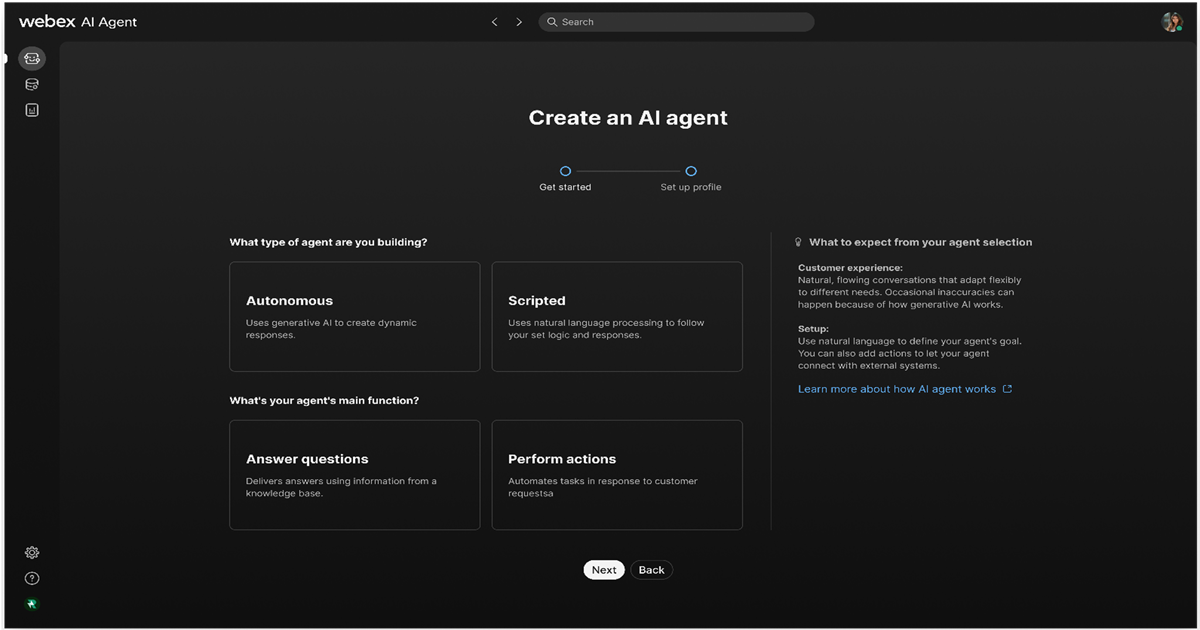
Webex AI Agent is a virtual helper that quickly handles customer questions and requests using natural language. The purpose? To reduce wait times and solve problems faster. According to the official announcement, “Webex AI Agent provides self-service options for scenarios like these, which can result in a 39% improvement in customer satisfaction, or CSAT, scores according to customer experience leaders.”
Webex AI Agent also makes it simple for businesses to create and launch their own intelligent virtual assistants. With AI Agent Studio, even non-tech experts can train these assistants to handle customer inquiries to free up human agents for more complex tasks. This AI "front desk" can be up and running in minutes and can be customized to use different AI models.
Webex AI Agent is expected to be available to cloud customers in Q1 2025, with on-premise trials starting Q2 2025.
“Customer experience can make or break a brand, and unlike other solutions on the market, the Webex AI Agent solves customer problems instantaneously and will fundamentally transform the experiences we have all reluctantly been using for far too long,” said Jeetu Patel, Executive Vice President and Chief Product Officer, Cisco. “We believe that in the next few years, a large majority of first-time calls will be handled by an AI Agent that will be just as interactive, dynamic, engaging and personable as a human agent.”
Cisco’s other tool that was announced, AI Assistant for Webex Contact Center, is set to launch early next year to shake up customer service. It offers automated guidance for busy agents and supervisors. Key features include context summaries, suggested responses and dropped call summaries to ensure continuity.
When an agent is required, context summaries facilitate seamless handoffs from an AI agent to contact center agent. All necessary background information is provided to continue the conversation while eliminating the need for customers to repeat themselves.
As for suggested responses, recommendations appear directly within the contact center platform to provide agents with the information they need right at their fingertips to reduce call times.
For dropped call summaries, interactions are captured and documented up to the point of disconnection.
Some other AI features announced by Cisco include:
- Agent Wellness, which uses AI to proactively manage agent breaks, schedules and support channels. Available Q1 2025.
- Topic Analytics, already available, which identifies common call reasons and customer issues.
- Automatic CSAT Scoring, launching in January, which evaluates 100% of customer interactions to address the challenge of low survey response rates.
These tools use advanced AI to make conversations with customers smoother and more efficient. Businesses can use these tools to solve problems faster, provide better customer service and build stronger relationships with their customers.
For the latest in CX, join the conversation at Future of CX Expo 2025, taking place in Fort Lauderdale, Florida, February 11-13, 2025. Dive into emerging trends, cutting-edge technologies and strategies that promise to shape the future of customer interactions. These include agent assist, conversational AI, generative AI and other types of AI, as well as analytics and automation, CPaaS, knowledge management, workforce optimization and more.Edited by
Alex Passett